Monday, August 10, 2015

Supreme Court Stays Imposition of Service Tax on Lawyers


Supreme Court 
Supreme Court bench comprising Chief Justice H.L. Dattu, Justice A.K. Mishra and Justice Amitava Roy has stayed the Bombay High Court’s order, dated 15.12.2014 in the case of P.C. Joshi Vs. Union of India of dismissing the petition challenging levy of service tax on lawyers.
The Bombay Bar Association has challenged aforesaid order as well as the provision of Sub-clause (zzzzm) of clause (105) to Section 65 of the Finance Act, 1994, which was inserted by the Finance Act, 2011.
Few of the  prominent questions of law, amongst others,  as framed before SC are as below:
Whether the relationship between an advocate and a litigant is that of a provider and a service recipient or whether the relationship is that of  a representative and a litigant ?
Whether the impugned judgment is correct and legal in as much as levy of service tax on the provision of assistance to the court would hit the provision of justice either by the individual or a business entity as both are indisputably guaranteed under right to justice in terms of Article 21 read with Article 39A of the Constitution ?
Bombay High Court 
It is pertinent to note that Bombay High Court while dismissing the petition held that
“the   taxable   service   means   any   service provided or to be provided   to   any   person,   by   a   business entity, in relation to advice, consultancy and assistance in any branch of law, in any manner.”
“legislature by inserting such provision has neither interfered with the role and function of an advocate nor has it made any inroad and interference in the constitutional guarantee of justice to all.  The services provided to an individual client by an individual advocate continues to be exempted from the purview of the Finance Act and consequently Service Tax but when an individual advocate provides service or agrees to provide services to any business entity located in the taxable territory, then, he is included and liable to pay Service Tax.’ The judgment also notes, ‘The Advocates and legal practitioners are known to pay professional taxes   and   taxes   on   their   income.     They   are   also   brought   within   the purview of service tax because their activities in legal field are expanding in the age of globalization, liberalization and privatization. They are not only catering to individuals but business entities.”

Best Regards
K.K Singh

FINANCE & LAW TODAY: Input Tax Credit and Inter GST Credit

FINANCE & LAW TODAY: Input Tax Credit and Inter GST Credit: Input tax credit is the amount of tax paid by  the dealer  on  purchases  for which the dealer is entitled to claim a credit. The input ta...

Input Tax Credit and Inter GST Credit

Input tax credit is the amount of tax paid by the dealer on purchases for which the dealer is entitled to claim a credit. The input tax credit has to be claimed by a dealer against tax invoice which can be adjusted against tax liability of the dealer. As we know that the current framework of tax structure allows limited inter-levy credits between excise duty (tax on manufacture) and service tax However, no cross credits are available across the sales tax paid (on input) or payable (on output) and these taxes. The GST will facilitate seamless credit across the entire supply chain and across all States under a common tax base.
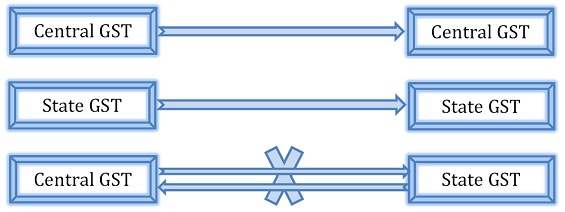
Introduction of GST should thus rationalize tax content in product price, enhance the ability of companies to compete globally, and possibly trickle down to benefit the ultimate consumer. However, it is learnt that under the proposed GST regime, the Centre will give input tax credit (set off) only for Central GST and the States will give input tax credit only for State GST. Cross-utilisation of credit between Central GST and State GST will not be allowed. Nevertheless, the dealers could claim set-off within the respective heads.
cgst
Presently, input tax credit is available under the Excise Duty and Service Tax on payment basis. However, under the State VAT, it is allowable on the basis of tax invoice, irrespective of date of payment. It is probable that tax credit under GST would be available on the payment basis. The dealers, who are presently registered under the VAT only, will have to accordingly adjust their business norms to avoid unnecessary blockage of working capital for payment of tax.
The Centre would levy and collect the Integrated Goods and Services Tax (IGST) on al inter-State supply of goods and services. There will be seamless flow of input tax credit from one State to another. Proceeds of IGST will be apportioned among the States. IGST model permits cross-utilization of credit of IGST, CGST & SGST for paying IGST unlike intra –State supply where the CGST/SGST credit can be utilized only for paying CGST/SGST respectively.IGST credit can be utilized for payment of IGST, CGST and SGST in sequence by importing dealer for supplies made by him.
igstIn GST, Nature of Sale/Service (i.e. taxable supplies) also determines the availability of input tax credit, which may be as under:
S.NoNature of SupplyAvailability of Credit
1Taxable SupplyYes
2Zero Rated SupplyYes
3Exempted SupplyNo
 Any one of the following documents for availing input tax credit may be prescribed as eligible document for claiming ITC:
  • The Invoice
  • Payment of Tax
  • Hybrid System
However to avoid leakage of GST, input tax credit might be allowed based upon e-return filed by the seller, sothat the amount of tax paid by the seller is reflected in the account of purchaser electronically.

Best Regards
K.K Singh

Wednesday, August 5, 2015

Section 68 can’t be invoked if Transactions made are through proper Banking Channel & Assessee proves Identity & Genuineness

Name of the Case:
KLR Industries Ltd. v DCIT (ITAT Hyderabad), Appeal No: 1480/HYD/2014, Date of Decision: 15/07/2015
Brief of the Case
In the present case there were the three issues which were decided by the Hon’ble Tribunal where it was held that whenever the transactions have been made through proper banking channel, then invocation of section 68 will not be valid. Further, the Tribunal on second issue remitted the matter where there was a doubt between borrowed funds and investment made. Then, on the third and the last issue it was held that expenses made during the previous year will not be made taxable in the current year.
Facts of the Case
In the present case there are different issues and all the facts of different issues have been dealt seperately. The relevant facts of different issues are as follows:-
  • Assessee is in a business of manufacturing of earth boring and drilling equipments. AO noticed that the assessee have introduced an amount of Rs.9,88,50,000 as share application money in its books of account in the names of 19 persons. It was explained that the share capital also consists of the contribution made by the Directors of the Company of Rs. 19,44,371 and Rs. 3,57,121 respectively. It was mentioned by the Aseessee that there were agreements with the persons concerned where both the Directors of the Company have given their undertaking to repay the particular amount taken. But AO observed that the assessee has neither produced any agreement nor they have produced any communication from the side of creditors which made AO to doubt the genuineness of the creditors. Therefore, the Ld. AO called Assessee to prove the identity of the creditors so that the genuineness of the Agreement could be proved. After going through the 7 confirmation letters the Ld. AO reached the conclusion that nobody have mentioned the source of money in their letters and doubted the genuineness of the money given to the assessee. The assessee was not able to produce the remaining 12 confirmation letters which created serious doubts in the mind of AO. As, a result the Assessee added the amount lend by 12 different individuals in the income of the assessee. [The amount received from the remaining 7 individuals were accepted by CIT(A)].
  • The second issue was that during the assessment proceeding, the A.O. while verifying the balance sheet of the company along with the books of account noticed that during the year assessee has made the investments out of the borrowed funds and the A.O. called upon the assessee to explain that why proportionate amount out of the interest expenditure shall not be disallowed, as investments made with sister concerns/related parties were not for business purpose.
  • The third issue was that during the assessment proceeding, the A.O. noticed that the assessee has debited an amount of Rs.25,46,846 as interest on other loans on which The A.O. was of the view that provisions of section 194A is applicable to such payments. Since the assessee has not deducted tax at source while making the payment, the A.O. disallowed an amount of Rs.21,67,937.
Held by the CIT(A)
  • Regarding the first issue of section 68 the assessee submitted 12 confirmation letters before Ld. CIT(A). On the basis of it Ld. CIT(A) called for remand report from A.O. Ld. CIT(A) observed that A.O. in his report has pointed out that information submitted by assessee do not substantiate the genuineness of the transaction and creditworthiness of the creditors. He also concluded that assessee has not furnished share applications made by investors nor produced any evidence to show that shares were allotted to them. According to Ld.CIT(A), the whole amount was the loan taken by Directors in their individual capacity as Directors undertook to pay the said amount individually by themselves. Ld. CIT(A) observed that no material has been furnished to prove that these amounts have been invested by share applicants for buying shares of the company. Ld. CIT(A) further observed that assessee even did not produce before A.O. the personal agreements. Thus, ld. CIT(A) by observing that onus is on assessee to prove that credits appearing in the books of account are share application money, which assessee has failed to discharge, confirmed the addition of Rs.7,44,34,609. As far as the amount of Rs.2,95,91,391 representing the investment made by seven persons in whose case confirmation letters were filed before AO, but, additions were not made, Ld. CIT(A) observed that in the remand report, AO has stated that genuineness of the transactions relating to the aforesaid amount is not established, hence, the amount of Rs. 2,95,91,391, though was not added at the time of assessment proceeding, also needs to be treated as unexplained credit and added to the income of assessee. u/s 68 of the Act.
  • In the second issue the learned CIT(A) also confirmed the addition made by the A.O. (for the order of AO see the contentions of Revenue).
  • Regarding third issue, Ld. CIT(A) after considering the submissions of the assessee and referring to CBDT Instruction No.1425 F.No.275/9/80-IT(B) dated 16.11.1981 directed the A.O. to re-examine assessee’s claim.
Contention of the Assessee
  • Regarding the issue of section 68 the Ld. AR of the Assessee submitted that names, addresses, PAN and assessment particulars, etc. were produced in respect of the seven individuals who lend money to the Assessee. Further, it was submitted that in respect of rest of the creditors, assessee has disclosed identity of the creditors with assessment particulars and all other necessary details with their bank account copies and when the creditors have confirmed of having made investment in the company, it cannot be said that assessee has failed to discharge its onus of providing cash credits. Ld. AR submitted, as far as the ingredients of section 68 are concerned, assessee has fulfilled the first ingredient of establishing identity of creditors which also the department has accepted. As far as the second ingredient, genuineness of the transactions is concerned, the transaction is through regular banking channel. Therefore, the only other ingredient remains to be fulfilled is creditworthiness of the creditor. Ld. AR submitted that when all the creditors have confirmed of having advanced the amount and it is reflected in their respective accounts and more over when all the creditors are income-tax assessees, no doubt can be raised with regard to their creditworthiness. Moreover, assessee having discharged the initial onus cast upon it, it cannot be expected to prove the source of source. Further it was submitted that whether it is share application money or investment, addition cannot be made at the hands of assessee u/s 68 if the ingredients of the said provision are not attracted. He, therefore, submitted, no addition can be made u/s 68 of the Act.
  • Regarding the second issue it was submitted by the assessee that the investments were for business purposes as the investment in Dubai were made to acquire an industrial facility in a free trade zone with a view to facilitate assembly of equipment exported by assessee company and market the products as made in UAE. Then, another investment in KLR Mining Equipment is concerned, it was submitted by the assessee that the amount was advanced to clear/pay off the liability of the concerned party to bank and to pay for the personnel employed by it as the assessee was operating from the same premises and in the event, the property is attached by the bank for recovery of their dues, then, the business of the assessee would have suffered. Also, the company has substantial reserves and the amounts advanced were out of such reserves and surplus and not out of interest bearing funds. It was submitted that even otherwise also the advances made were for the purpose of business. Regarding further investments, the assessee submitted that the amount of Rs.1,32,86,987 was advanced to M/s. KLR Mining and Equipments Ltd., which is a sister concern of the assessee. The said company went out of production but it has substantial plant and machinery and sheds. The assessee also stood guarantee for some loans taken by the said company from bank. Thus it was submitted by the learned A.R. that disallowance of interest is not justified.
  • Regarding the third and the last issue in which non-deduction of TDS is under dispute. Before the first appellate authority, it was submitted by the assessee that since the payment was towards EMI of the hire purchase agreement it will not come within the purview of section 194A of the Act. He also submitted that provisions of section 194A will not be applicable to interest paid to banks. Since the entire interest amount was paid during the relevant previous year and nothing remained payable, no disallowance under section 40(a)(ia) can be made in view of the decision of the ITAT, Vizag Special Bench in the case of Merlyn Shipping and Transport 146 TTJ (1).
Contention of the Revenue
  • Regarding the first issue, the ld. Counsel for the Revenue submitted that no proper documentary evidence at any stage of the proceeding were produced. None of the creditors admitted of having advanced the amount as share application money. The Ld. Counsel mentioned the Judgment of Hon’ble Supreme Court in the case of Rajendran Chingaravelu vs. Addl. CIT & Others (2010) 320 ITR 1 (S.C.) and argued that income tax authorities are well within their powers to not only satisfy themselves that money is from legitimate source, but also satisfy themselves that money is going to be utilized for legitimate purpose. Thus, the assessee have failed to explain the credit in this case. Therefore, addition was justified.
  • Regarding the second issue of investments from the borrowed funds the ld. Counsel for the Revenue relied on the orders of AO where the A.O. observed that the assessee did not adduce any evidence to show that the investment made is for the purpose of assessee’s business. Further he opined that even if it is accepted that assessee has utilized the investment for assembling equipment in an industrial unit in Dubai but the same is going to be a separate entity taxable under the tax laws of UAE. Also, he observed that when interest bearing funds of assessee were utilized to meet liabilities of another company, it cannot be for the purpose of assessee’s business.
  • Regarding the third issue the Ld. Counsel for the Revenue supported the disallowance of interest as made by CIT(A).
Held by the Tribunal
  • The Hon’ble Tribunal on the first issue observed that it was on the record that the advances were actually obtained by the Director’s from their known persons and on their advice it was shown as share application money in the books of the company since capital was required for the company to diversify its activities to real estate business. It is also a fact on record that all the creditors have not only confirmed of having advanced the amount in question, but the entire transaction is through proper banking channel by way of cheque or DD. In the facts of the present case, it is a matter of record that the assessee has produced confirmation letters in respect of all the creditors wherein not only the identity of the creditors with their address have been furnished but income tax particulars including PAN has also been given. Therefore, the identity of the creditors remains established. Also, it is evident, that the entire transaction has been through proper banking channel. Therefore, as far as the assessee is concerned, the genuineness of the transaction has been established as not only the transaction is through banking channel but the source of such credit has also been proved by the assessee. Now coming to the third ingredient, the creditworthiness of the creditors, it is to be noted that all the creditors have not only confirmed of having advanced the money to the assessee but have also stated that it is out of their own sources. It is also not disputed that all the creditors are income tax assessees’ in the role of the department. Only because the credits have been shown as share application money in the books of accounts of the assessee, it will not automatically lead to the conclusion that the amount received is unexplained credit. Regardless, whether the advances were towards share application, as claimed by the assessee, or investment as stated by the creditors in the confirmation letters and affidavits, fact remains that the assessee has proved the source from which such credit has come to him. Therefore, no addition under section 68 of the Act can be made in the present case.
  • Regarding the second issue it was mentioned by the Hon’ble Tribunal that the primary contention of the assessee is that the investments made are out of surplus fund and no interest bearing fund has been utilized. The aforesaid facts require verification since if there is no nexus between the investment made and the borrowed fund, then, no disallowance can be made. As these aspects have not been examined by either A.O. or learned CIT(A), the matter was remitted to the file of A.O. to verify and take a decision in the matter, after giving due opportunity of being heard to the assessee.
  • Regarding the third issue, the Hon’ble Tribunal mentioned that while relying on Vizag Special Bench in the case of Merylin Shipping and Transport (supra), no disallowance under section 40(a)(ia) can be made if the entire amount was paid during the relevant previous year and nothing remained payable. The Hon’ble Allahabad High Court also in case of CIT vs. Vector Shipping Services P. Ltd., 357 ITR 647 expressed similar view. Therefore, following the aforesaid decisions, the Hon’ble Tribunal directed the A.O. to verify and allow the deduction claimed, if it is found that the entire amount was paid during the relevant previous year and nothing remained payable.

Best Regards
K.K.SINGH

Sunday, August 2, 2015

FINANCE & LAW TODAY: GST: Hyped Are The Merits, Hidden Are The Threats

FINANCE & LAW TODAY: GST: Hyped Are The Merits, Hidden Are The Threats: Introduction:- The Goods and Services Tax (GST) is the most awaited reformation in the indirect tax structure of India which is planned...

GST: Hyped Are The Merits, Hidden Are The Threats


Introduction:-
The Goods and Services Tax (GST) is the most awaited reformation in the indirect tax structure of India which is planned to be implemented w.e.f. April 1, 2016. It has been the most happening topic in the parliament since December 19, 2014 when The Constitution (122nd Amendment) (GST) Bill, 2014 was first presented by the Finance Minister, Mr. Arun Jaitley in the Lok Sabha. In this piece of writing, the authors have made an attempt to give an insight of merits and probable threats in GST proposals.
About GST:-
GST is a Value Added Tax proposed to be levied in lieu of manufacture, sale and consumption of goods and services. It will replace all indirect taxes whether levied on goods and services by the Central and State governments including Central Excise Duty, Countervailing Duty, Service Tax, Value added tax, Octroi and entry tax, luxury tax, etc. It will be implemented concurrently by the central and state governments as the Central GST (CGST) and the State GST (SGST) respectively. Exports will be zero-rated and imports will be levied the same taxes as domestic goods and services adhering to the destination principle.
Benefits of GST:-
A number of countries in the world have already switched to GST. There are a number of advantages of GST over the existing indirect tax structure due to which India is looking forward to implement the same. Some of the key advantages of GST are as follows:-
  • Wider the tax base, lower the tax rates:-
Currently, a no. of taxes and duties are being imposed on the same item right from the stage of manufacture until the same is consumed. These are levied in form of import duty, excise duty, octroi, luxury tax, service tax, VAT, etc. The total of these taxes is around 35%-40%; while rate of GST is to be kept around 16%-18%. This is one of the key rationales of introducing GST.
  • Removing cascading effects:-
The foundation of an indirect tax is kept keeping in view the cascading effect and due provisions are framed to lower down the same. However, more the no. of taxes, more the cascading effect. When we talk of excise duty, service tax or VAT, there are Cenvat credit rules which allow the credit of input tax/duty suffered by the material or service so used. Still there are cases where the cascading effect is clearly visible but there is no mechanism in the law to deal with it. For eg. entry tax, octroi, etc. Almost every goods are subject to these taxes but no credit is allowable as these are collected normally by local bodies. Thus, ultimately these taxes form part of the cost of product which is further subject to excise duty or service tax or VAT. Thus, cascading effect do exists. This particularly happens when the same goods or service suffers a no. of taxes and no set off facility is available. Implementation of GST will bring drastic reduction in the cascading effect as most of the indirect taxes prevailing at present will get subsumed in GST and credit will be allowed on the inward taxes .
  • Resolution of classification related disputes:-
One major area of dispute is the “classification of goods and/or services”. It would be interesting to know that there have been cases where the litigation arose on the fact whether a particular item/activity is goods (i.e. excise duty will be levied) or service (i.e. service tax will be levied). More interestingly, the said litigation was settled down by the Supreme Court decisions. One such case was of Software. Sales tax department issued notices treating the same as sale of goods while service tax department issued notices treating the same as provision of services. This issue was settled down by Supreme Court in year 2004 in the case of M/s Tata Consultancy Service. In this case, it was held that if a property is capable of being abstracted or consumed or used or transmitted, it is leviable to tax as sale of goods. There was another case of sim cards. In the year 2006, Supreme Court gave a landmark judgment in the case of M/s BSNL and others wherein it was held that if the sale of the SIM card is merely incidental to the service being provided and facilitates the identification of the subscribers, their credit and other details, it would not be assessable to sales tax. While giving this decision, Supreme Court held that both the taxes cannot be levied on single transaction. But interestingly, even after this judgment there are several transactions which are subject to both service tax and excise duty. Further, there is a concept of works contract, both in the VAT law as well as in service tax. Though in both the laws, there is a provision of abatement or composite scheme, still there is part of total value which is subject to both VAT and service tax. All these problems will come to an end after implementation of GST.
  • Rationalization of tax structure & simplification of compliance procedure:-
At present, there are multiple indirect taxes which are levied by different bodies, Central Government, State Government, Local bodies, etc. All these governing bodies have their separate offices, rules and regulations. An assessee has to move from one office to another for procedural formalities. Also, there are cases where for complying the rules of one governing body, the assessee fails to comply with rules of another governing body. Implementation of GST will bring substantial reduction in these formalities as there would be only two governing bodies namely Centre for CGST & State for SGST. This will save time, money and energy of assessees.
  • Reduction in duplicity of information and compliance costs:-
In the present structure, same information is to be filed at several places for the same goods/service. This increases cost of assessee and also the duplicity of information. Not only assessees, overall cost of government; is also increased as the same information is being stored at several places which has to be maintained by employing man, money and energy. This ultimately leads to inefficient utilization of nation’s resources.
  • Increase in product competitiveness in international market:-
With the implementation of GST, in long run, there will be reduction in overall cost of products manufactured in India. This will make Indian products more competitive in International market. It is worth mentioning here that many of our top competitors in the international market have already switched to GST. Implementing GST in India will be a step forward in making our product more cost effective in international market.
PROBABLE THREATS IN GST PROPOSAL:-
Lots of publicity has been made about the benefits of implementing GST. However, on going through the GST proposal, it is found that there are some grey areas which sighs that it is nothing but a carry forward of VAT, excise duty and service tax in new name and fame. Let’s have a look on these areas of negativity of GST:-
  • Rate of GST: It’s on higher side:-
Earlier GST was proposed to be implemented with a rate of 27%. However, later on it has been clarified that the rate will be around 16-18%. Perhaps it has been done to bring GST rates at par with those prevailing in the international market. Normally, GST rate varies from 16% to 20% in international market. However, it is worth noting here that Malaysia has recently adopted GST in year 2015 only with the rate of 6%. Also, there is example of Australia which has GST rate of 10%. Thus, keeping the latest international trend in mind, the rate of GST still needs revision on lower side.
  • Decision making process in GST Council:-
In the proposed GST Bill, one vote has been assigned to each State in the GST Council. As per Government, this has been done to ensure that small states should not lag behind in the GST Council. However, if we look into the decision making process at GSTC, we find that there is possibility that the role of small states will be negligible in the vital decisions. It has been proposed that “Decision in GSTC shall be taken at a meeting, by a majority of not less than three-fourths of the weighted votes of the members present and voting, in accordance with the following principles, namely:-
(a) The vote of the Central Government shall have a weightage of one fourth of the total votes cast, and
(b) The votes of all the State Governments taken together shall have a weightage of three-fourth of the total votes cast, in that meeting.
And the vote of each state shall have a weightage proportionate to the population of that State. [emphasis supplied]
Thus, while assigning the weightage to vote, the population has been made the prime criteria. It is worthwhile to mention here that there are certain states which have very less population but their share in taxes is on much higher side. Such states, though contributing more, will lag behind in the decision making process taking place at GST Council.
  • 1% additional tax on supply of goods:-
It has been proposed to levy an Additional Tax not exceeding 1% on supply of goods in course of inter-state trade or commerce would be levied and collected by the Central Government. This tax would be assigned to the States in which the supply originates for two years or as recommended by the GST Council. This will be a non-vatable tax. Thus, this tax itself seems to be against the very basic vision of GST which says that there will be no-cascading effect in GST. This 1% tax will ultimately become cost of goods as no Credit of this tax would be allowed.
  • Compensation to loss making States for five years:-
It has been proposed that the Central Government will compensate the loss arising out to States on implementation of GST for a period of five years. The compensation will be on a tapering basis, i.e., 100% for first three years, 75% in the fourth year and 50% in the fifth year. This has been done to make the States affirmative towards the implementation of GST. However, there is a possibility that States may not take effective steps for smooth run of GST as they are being compensated for the losses. It is also possible that the actual loss is much lower than that shown on records in order to get higher compensation. The Central Government will have to take steps to ensure that this proposal in the GST bill is not misused by the States.
  • GST Proposal: Not friendly to important service sector like banks:-
It is much hyped that GST will bring Indian goods a step forward in the International market. The reasons so given are that the GST will make Indian products cheaper in long run and thus will promote exports. In this regard, it is to be noted that the banking sector pays an important role in the exports. Whether it is export of service or export of goods, the role of banks is vital. It is worthwhile to mention here that at present service tax @ 14% is being levied on the banking transactions. On introduction of GST, this rate will be on much higher side as predicted. This will ultimately increase the cost of transaction, particularly, in case of imports and exports where huge amount is transacted. It is also interesting to note that in most of the countries, banking sector is excluded from the purview of GST. The cost of transaction there is obviously on the lower side. On the other hand, the cost of banking transaction, which ultimately becomes the cost of product, will increase after implementation of GST. Similar is the case with other important services like advertisement and sales promotion which play a crucial role in exports of a country.
  • Dispute resolution mechanism:–
It has been proposed that the GST Council will lay down criteria as to how the disputes arising out of its recommendations will be resolved. In other words, the disputes arising out of recommendations of GSTC will be resolved by GSTC itself. This is like a party to dispute has been given authority to make the judgment. It is against the principles of natural justice. A question was raised on this proposal which was explained by the Government that if any separate body is constituted for dispute resolution, it will hamper the working of GSTC in general and of legislature in particular. However, even after this explanation, there are possibilities that the decision taken on the disputes are not true and fair, particularly when they relate to small states which possess lower voting power (since voting weightage is based upon population). If any separate body is not constituted, the task of laying down the dispute resolution mechanism will be the toughest one.
While parting:-
The introduction of GST along with other government initiatives like the ‘make in India’ programme have the potential to drastically bring down costs, re-define and re-shape the economy of India. The benefits of implementing GST have been much talked but the probable threats have only been popularized as opposition party’s publicity stunts to hamper the implementation of GST. Whatever be the case, the fact is that these probable threats in GST should be taken care of before the bill turns into Act; else the GST will only carry forward the demerits of existing indirect tax structure, thereby becoming an old wine in new bottle.

Best Regards
K.K SINGH

Friday, July 31, 2015

FINANCE & LAW TODAY: Focus Areas in Vat Assessment

FINANCE & LAW TODAY: Focus Areas in Vat Assessment: Let us understand the words VAT assessment on individual basis. When I say assessment it means to check something of it’s correctness or ve...